

By Ray Hanania
OPINION: High School District 230 Board President Lynn Zeder and the Board of Trustees blocked a motion that would have opened a formal public discussion at its meeting on Thursday, Jan. 29, 2026, on a proposal by Trustee Mohammed Jaber to add Arabic to the school’s World Language Curriculum.
The motion died without a second or even allowing Jaber to address the issue in his motion, a violation of Roberts Rules of Order, which applies to all public bodies in Illinois, including school districts.
The board's silence came after more than three years of delays and bureaucratic obfuscation against the proposal that Jaber made after he was elected and that he formally requested to be introduced last August. His motion was formally introduced for this board meeting after years of “informal discussion.”
Had Jaber’s motion received a second, it would have allowed for an open and public discussion about the issue. The board could have easily allowed a discussion and tabled it for further study. But topics involving the growing Arab community, given District 230’s history, are avoided.
Instead, it was shut down and only briefly addressed in board member comments at the end of the meeting. Additionally, the video of the meeting was also removed from District 230’s YouTube channel the following morning on Friday, Jan. 30, 2026.
Blocking the motion keeps it under Zeder’s control and restricts the discussions to “informal” sessions outside of the public domain.
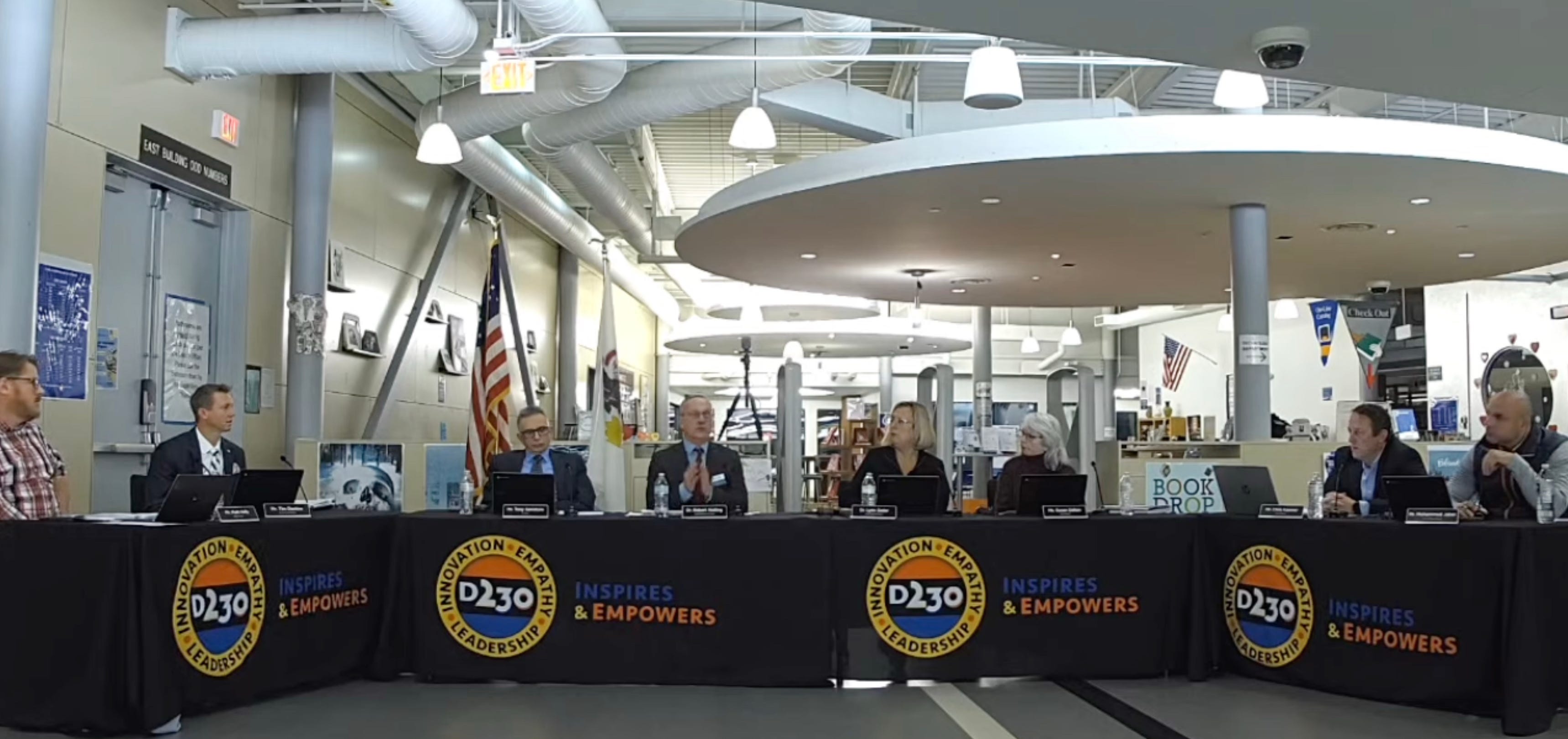
Zeder called the motion out in “Old Business,” when in fact Jaber made the motion for the very first time and should have been recognized as a New Motion.
The topic has been “discussed” informally in the past. Jaber was allowed to read the motion, although as he spoke, the school district’s online audio system went silent, so his words could not be heard.
Jaber should have been given the opportunity to explain his motion so the board’s trustees could decide to second it, support it, or reject it.
According to Robert’s Rules of Order Newly Revised (RONR), a member (including a trustee) who introduces a motion is entitled to provide a brief explanation or description of the motion immediately after making it and before it is seconded.
District 230 often skirts Robert’s Rules of Order, which apply equally to municipalities and all school districts, to manage what is said about issues at public board meetings.
When Zeder asked for a “Second” to allow it to be part of the board’s public discussion, every board member, including Zeder herself, and Trustees Chris Kasmer, Tim Danlow, Tony Serratore, Susan Dalton, and Mark Kelly, all remained embarrassingly silent.
Forced to speak to the issue at the very end of the two-hour meeting during “Board Member Comments,” Jaber expressed his frustration at the board’s continued delays.
He explained the proposal wasn’t designed solely to strengthen the needs of Arab students, who make up 35 percent of the District’s student body, but rather to give “all students” a chance to learn a language critical to international business, where the Middle East has become a cornerstone of the World economy.
“I am disappointed it wasn’t seconded,” Jaber said at the very end of the meeting.
“This was discussed three years ago with emails, discussions, with Dr. Katie McMillan, Dr. Anita Hoffman, Dr. Nolting, Dr. Lynn Zeder, and previous board members. … The can has been kicked down the road for three years. We’ve had multiple discussions. We had five public board meetings regarding this. Two committee meetings, two board meetings, and one, technically a board discussion, board comments after an executive meeting, so we had five public meetings regarding this.”
Jaber argued it made no sense to prevent a public discussion now at the board meeting, noting other attempts to address major motions normally only required two informal discussions before being voted on and approved.
“We’re telling our students, ‘We don’t want you to succeed on the Seal of Biliteracy. We don’t want our students to get scholarship opportunities. We don’t want our students to get well-paying jobs in your government and financing. Especially when the US is partnering with a lot of Arab countries,” Jaber argued.
“But this is just not for one particular group. It’s for everyone. There’s an interest out there, but yet my fellow board members have decided to punt this. More discussions. More discussions. That’s all we do. More discussions. It’s like, ‘Okay, how about action?’ Or ‘Well, hmm, I’m not there yet.’ I’m just tired of discussions.”
The Arabic Language Curriculum proposal was first introduced by Jaber three years ago, but has languished under oppressive bureaucratic maneuvering by Zeder without explanation.
District 230 has had a long history of bigotry targeting the growing Arab American student population, which in the 1990s was only 10 percent of the student population but has increased to more than 35 percent now.
During his brief remarks at the end of the meeting, Kelly said Jaber’s motion will be again be “discussed” in February, although no specific details were offered.
“Tonight, a motion was made about the Arab language. Next month, we will be having an informational meeting to establish an Arabic World Language class,” Kelly said during his board comments at the end of the meeting.
“We have plans to be made, questions to be asked, concerns and caveats to discuss. But the work has begun, and it will continue. This community of taxpayers has asked for a change in the curriculum. And that request has been heard, and that request will be honored.”
Not mentioned or acknowledged was a memo attached to the board agenda from Supt. Robert Nolting, who seemed to express support for the motion, laid out the history of the idea.
“Background: In August of 2025, the D230 Administration responded to board requests to review the process for adopting Arabic as a World Language offering to align with current offerings such as Spanish, German, French, and Latin. The meeting reviewed the unique challenges of adding a comprehensive, four year language offering based on teacher certification/availability, curriculum alignment, and aligning to either a heritage program or acquisition program. Over the past four months, the Administration has pursued pathways for staff certification, requesting information from ISBE on current certifications, university partnerships, and networking with schools to help design a curriculum. This process has been done in parallel with work being done to adopt a History of the SWANA (South West Asia and North Africa) course aligned with Moraine Valley Community College and the ongoing work currently underway through the World Language program review that is aligning current courses to American Council on the Teaching of Foreign Languages (ACTFL) and College Board standards. Due to a board request, the administration has been requested to move this curriculum process towards action.
“Recommended Motion: I move that the School Board adopt Arabic as a World Language for the 2027-28 school year.”
That was originally recommended by Nolting to read as the official motion, but without explanation, it was rejected and not acknowledged.
Nolting remained silent during Zeder’s obvious political maneuver to block public discussion, and the board also remained unusually silent.
Four parents and a professional Arab language instructor who identified himself as being Jewish, expressed support for the addition of Arabic to the Language Curriculum.
“Arabic is one of the most widely spoken languages in the world and is deeply connected to global business, diplomacy, technology, and culture exchange. Um, just to cut it short, um, urging the, the board to view the Arabic program not as an expense, but as an investment, uh, one that expands opportunity and strengthens the curriculum,” said public speaker Marwa Al-Sayed.
Federico Luque Macias, who has been teaching on the Chicago Public Schools since 2016, urged it be approved.
“Opening an Arabic program in these times in any district in Illinois, really, it’s a very positive thing and a thing that has a lot of future,” said Macias, who noted he is Jewish.
“I’ve worked closely with the Qatar Foundation International. I’ve, I’ve worked with programs from the Department of State, like the Critical Language Program. Most people I talk to, they don’t know that Arabic is one of the languages that the US government considers a critical language. As such, it has support. I’m currently working on a proposal for a Senate resolution of the State of Illinois to promote the Arabic language and give it protections that they have at the federal level, but not at the state level.”
Orland Park resident Michael Suri told the board it would be “important progress” to teach Arabic at District 230, expressing concerns the district should continue to resist those who oppose “diversity.”
Click this link to view the video of the board meeting.
President Zeder said at the January board meeting she wanted to have a "discussion" at the February board meeting about adding Arabic to the District 230 schools. But that came ONLY AFTER Trustee Mohammed Jaber introduced it as a motion at the Jan. board meeting. The District has already had five discussions -- more than on any other subject.
The issue isn't just about Arabic -- go to Facebook and read many of the bigoted comments being posted on the Southtown Story.
This issue is also about a fight IN the Arab Community over leadership and control.
Zeder, who was appointed under Pekau in 2022 and quickly became board president, has some support from some Arabs jealous that Jaber is a board trustee, including by several who ran and failed to win seats.
Jaber is very "American," and some Arabs don't like that. This small group of Arabs want to take control of local Arab American politics to get themselves elected so they can promote themselves and push radical agendas, which sadly play into the hands of the bigots.
Chariman Zeder is quite obviously not in touch with international and local economics we need Arabic and Chinese being taught in the schools as options to awaken our students that English is basic and it should be complemented by languages and alphabets other than our own.