

By Ray Hanania
When I was growing up, I noticed that the Israeli spokespeople who appeared on American television or radio would use a very specific tactic to undermine the Arab and Palestinian spokespeople.
During the debate, the Israelis would hone in on their opponent’s easily provoked emotions by saying something like “You don’t exist,” or “The Palestinians don’t exist,” or “Palestine never existed.”
It was very provocative but effective, and it caused Palestinian rights champions to turn to emotion in the debates, raising their voices, being animated, exaggerating suffering (that didn’t need to be exaggerated because expulsion and murder are horrible), and thereby making themselves easy targets to brush aside in the eyes of the American public.
Their emotions would undermine their arguments and strengthen the Israeli argument in the eyes of the audience, the American public.
Arabs were used to being very emotional. Their leaders were known for lengthy emotional speeches that lasted two to three hours. It was an image that turned off Western audiences and allowed the Israelis to play the victims.
The strategy Israel officials and lobbyists pursued from day one was to present themselves as the victims, building off of the Holocaust, the policy of the Nazis to destroy the Jewish people.
Israelis went out of their way to appear calm, a characteristic of being confident in their assertions and expressions. Anger is a sign that your arguments are weak, and you use the anger to reinforce your points artificially and to bully audiences.
It was a horrible, unintentional, or unavoidable strategy on the part of the Arab spokespeople that contributed to the bonding of the American public to the Israel spin, which was built on many political lies, even to the point of blaming the Arabs for the Holocaust.
But 50 years ago, as I was emerging into the early path of my journalism and political career, having just been honorably discharged from serving America in the US Air Force during the Vietnam War, and re-entering college at the University of Illinois at Circle Campus, I was able to apply my understanding of communications to put one of Israel’s most eloquent spokespeople in check.
I had published many Letters to the Editor in national publications like Newsweek and Time magazines, the New York Times, and the Chicago Tribun,e defending Palestinian rights, without emotion.
Those letters came to the attention of Ibrahim AbuLughod, the political science professor at Northwestern University, and Edward Said, one of the Palestinians’ own most notable and eloquent spokespeople.
They asked me to help the Arab American Congress for Palestine, which was based in Chicago, to be their spokesperson.
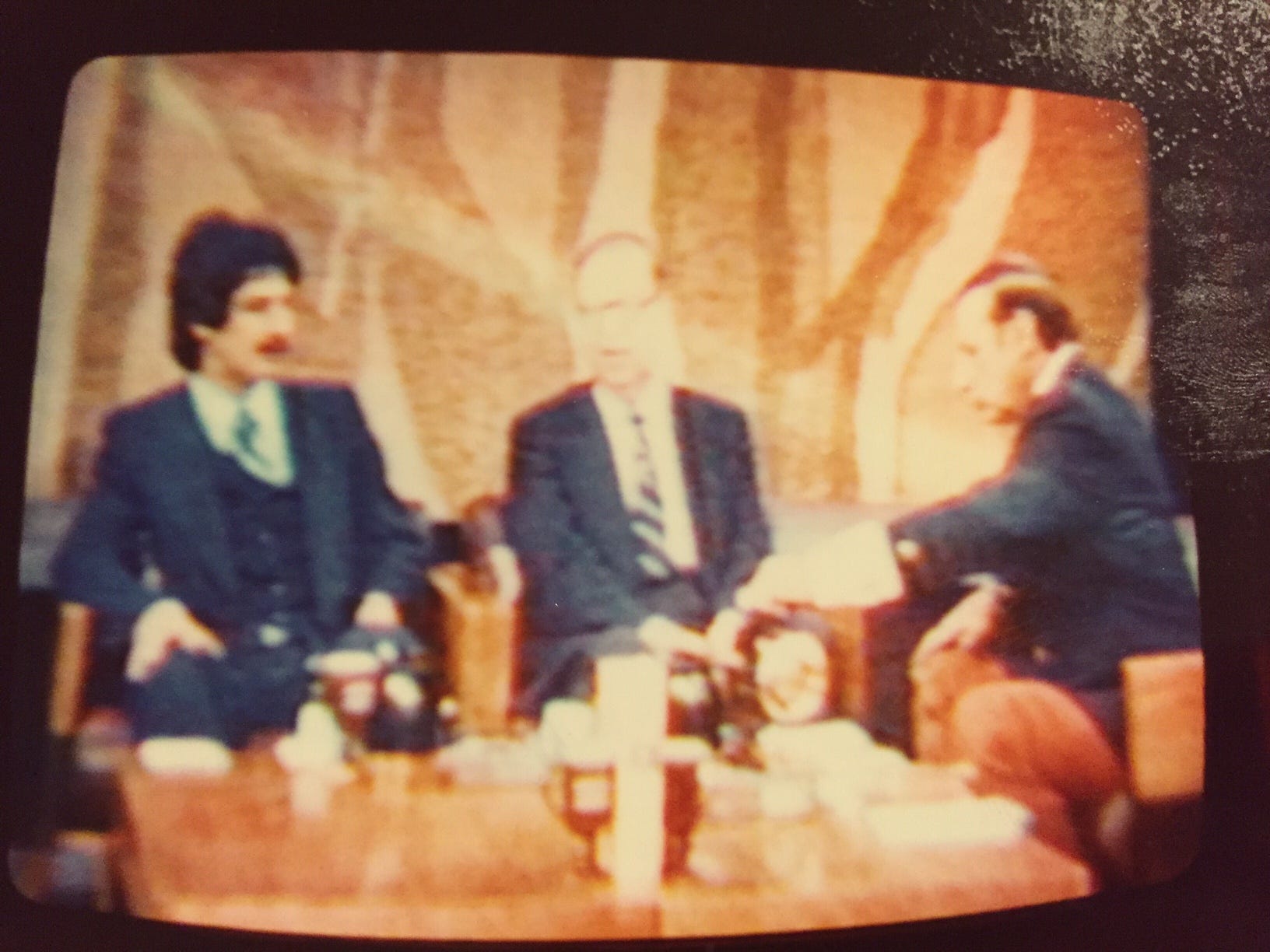
That prompted an invitation in early 1976 from Irv Kupcinet, who hosted a nationally televised program called “Kup’s Show,” to appear with Abba Eban, the former Israeli UN Ambassador and Foreign Minister, to discuss the Israel-Palestine conflict.
During the debate, Eban began trashing the idea of two states, calling it a political quagmire. Eban compared what we now call the “Two State Solution” to the failed “BeNeLux Union” in which Belgium, the Netherlands, and Luxembourg struggled to establish a collaborative economic and political government oversight. It took 14 years for that system to work efficiently, and it became the basis for the European Union, but it had its may troubles, which Eban was citing.
Eban also pointed a finger at Palestinians, blaming them for the violence, without mentioning Israel’s violence against Palestinians.
That was a key foundation of Israel's strategy, spotlighting Palestinian violence, comparing it to the Holocaust, blaming it on anti-Semitism, as evidence that the Israelis were the victims, and at the same time, playing down the violence by Israel that often was the cause that provoked Palestinian violence.
He tried to drag me into that debate, which was not winnable considering that it had been played out hundreds of times before the American public in past debates. The Arabs had lost that argument years before, reinforcing that loss with their angry emotional outbursts and their lack of strategic Public Relations and Communications methods that Israelis employed to the max.
But I didn’t take the bait. I knew I could win that argument in a one-hour TV show. So, I shifted the focus to expose Eban, who, by the way, I found later to be a decent person despite his total disregard for Palestinian suffering.
I shifted the debate to something more personal that hit to the heart of what the real problem was, understanding that in effective Public Relations and Strategic Communications, it is NOT what you say, but how you say it, and another principle (in my 2016 book that I wrote, PoweR PR), before you can win the argument, youmust WIN the audience first!
I began my response this way to Eban’s criticism of Palestinians and Israelis being able to come together, and his distorted history of Palestinian and Israeli relations:
I looked into the camera, at the audience, not Eban. Because it wasn’t personal or emotional to the politics. It was emotional in a way that connected with the audience I was speaking to, the American people, and I said:
“How is it, Mr. Eban, that you were born in South Africa and your real name is Aubrey Solomon. You immigrated to Palestine and live in Jerusalem. You can buy land. You can walk freely without harassment. Yet, my father, whose name was George Hanna Hanania, a Christian born in Jerusalem, whose father and grandfather and great relatives were born in Jerusalem … he could not go there. He could not own land, including his own former home in West Jerusalem on Jaffa Road, where his family lived for centuries. He died a few years ago, and he couldn’t even be buried in Jerusalem, where he was born.
“Maybe you want to explain that to the American people, rather than distract them from the reality with the BeNeLux System, explain that political quagmire to the American people whose tax dollars fund your country and your discriminatory policies?”
I continued, “My father served during World War II with his brother, Moses, to fight the Nazis and free the Jews in Europe, to end the Holocaust. And what was his reward? He could never even return there with any dignity or respect,” I said.
Eban was surprised and shocked at the response. He didn’t want to talk about how he was born in South Africa. Kupcinet, who years later became a good friend and would always cite how I bested Eban years before on his show, was angry and kept interrupting, wanting me to talk about the issue Eban raised, not the issues I had just raised.
How you argue has an impact on either breaking stereotypes and lies or reinforcing them. It has been a difficult life trying to convince Arabs and Palestinians that truth is important, but more important is how you present that truth to the audience, the public, the people who have a major impact in deciding your fate.
It continues to be a struggle in which many Arabs and Palestinians turn to anger and emotion, which easily is cast as “hate” and “anti-Semitism” when they address this tragedy.
Of course, I could have been emotional. My mother, who was from Bethlehem, and my father, both lost so much when Israel took over in 1948 and declared a Jewish State. My parents were Christian, and they lost all of their lands and possessions. I continue to fight for what’s left, 8 1/2 acres (33 Dunums) of land adjacent to East Jerusalem called Sharafat.
One day we will have peace with the audience, the American public that funds this continued conflict, sees the truth.
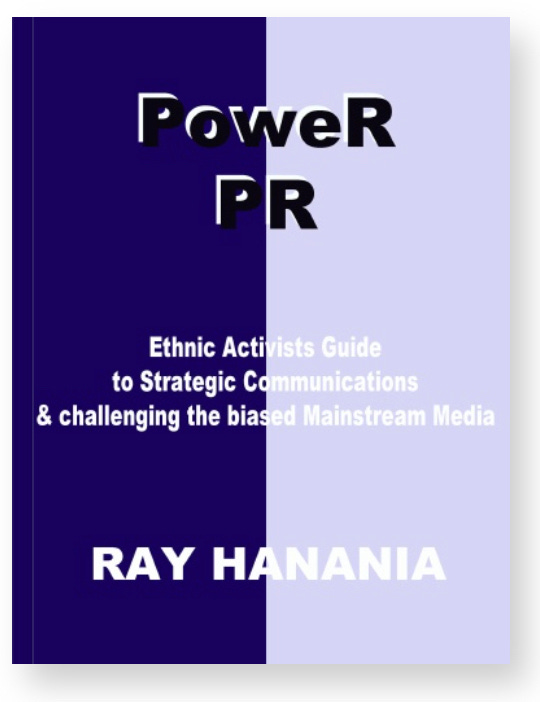
Check out my book, “PoweR PR: Ethnic Activists’ Guide to Strategic Communications.” It might change minds about one of the most complicated problems in the world. CLICK HERE for info on the book.
How did u find "Eban's" history, decades before the internet? Very intelligent to know as much as possible before walking into the debate. The only thing I would say is that the main reason the Zionists had a stranglehold on the American opinion in the 20th century is not because of how Arab commentators debate, rather it was almost impossible to get independent news. All of the corporate mainstream news went through rigorous Zionist filters. I use the word Zionist because the growing number of erhnic Jews who don't subscribe to the racist ideology. In high school and college the newspaper in my South-eastern Wisconsin town had editorial section and in early 2000s I would send in letters several times a year. When my letter would get published it almost always was followed the next day by an editorial from an out of town Jewish organization member trying to discredit my opinion. How did they get it published the next day? My.letters took weeks to show up in print. Obviously the local paper in my mid sized town had instructions to not publish anything sensitive to the Zionist narrative until it had a response ready.
I assume almost nobody had a VCR in those days so u probably don't have the video. Maybe the tape still exists in some archive somewhere. At least u have a Polaroid 😃.