

By Ray Hanania
There are so many great elected officials, and a few that are terrible.
But under the glow of the attention we place on them are many hard workers whose efforts help to make municipal government successful.
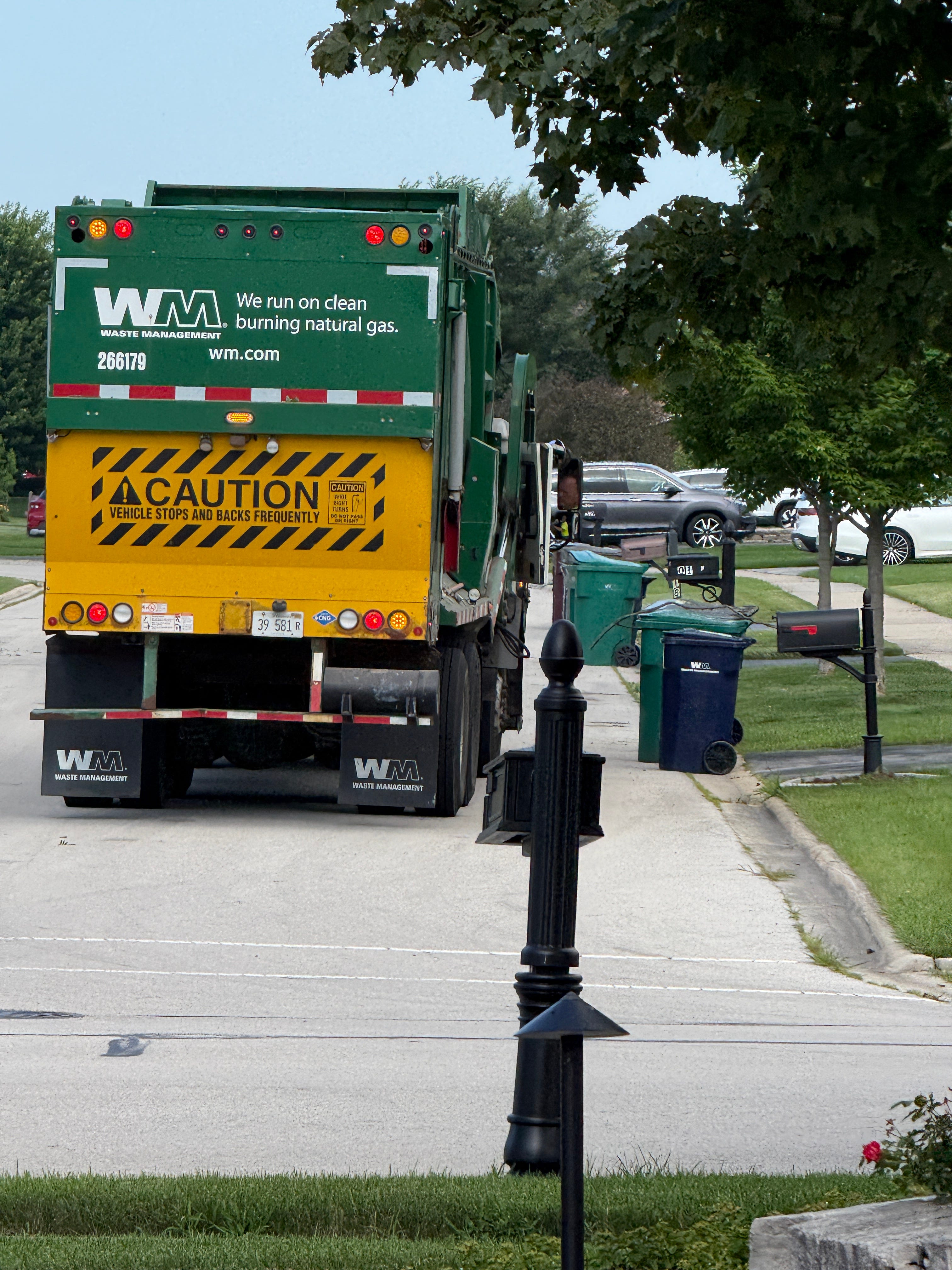
I’m talking about the waste haulers, recyclers and the lawn waste collectors.
Every week without fail, these men — and I have seen at least one woman — do the job that many do not want to do. They are often disparaged by indirect insults to others.
Yet, without them, the waste, recycling and lawn waste haulers, our society would collapse under the weight of our irresponsible abuse of resources and the growing threat of plastics, a word made famous in the 1967 Hollywood movie, The Graduate.
Here’s some things to consider:
The average American family throws away up to 5 pounds of garbage every day. That’s almost one ton of solid waste each year.
There are 340 million Americans and that means, on average, and every day, Americans throw out 850,000 tons, or as much as 300 million tons each year. These numbers don’t even include industrial waste, which is enormously larger.
The public looks down on the “waste haulers,” but they are so essential to our lives. They’re a necessity. And we take them for granted and we shouldn’t.
Being a “garbageman” used to be a great way for some to find work. When I was growing up in the 1950s and 1960s, there were four-man teams on each garbage truck and they would pick up just the garbage, an average of one garbage can per home, sometimes two.
In the 1950s, homes had cement garbage bins with a metal flat in front and on top. Wasste haulers shoveled the garbage out of the cement containers and tossed it into the back of the truck. There were three people, the driver, and two shovelers who took turns between shoveleing and picking up loose garbage and throw-away bulk items.
In the 1960s, they started shifting away from the cement garbage containers to metal (usually steel) garbage barrels with heavy lids. They then moved to lighter weight aluminum garbage cans. The hardware stores started pushing garbage cans and some homes had two and even three.
One man would drive, two to three men would lift the heavy garbage cans and empty them into the back while one would pick up the loose items or garbage that spilled out from the emptying of the cans.
It was so important that aldermen in Chicago where we lived on the Southeast side near Pill Hill at 87th and Jeffery Blvd would come around to the voters and offer them new aluminum garbage can lids to replace the ones that were old steel and rusted, had been damaged, or were stolen by recyclers.
The aluminum garbage can lids had a handle and kids would often use them as shields replicating scenes from the 1958 Hollywood blockbuster, The Vikings, starring Kirk Douglas and Tony Curtis.
Today, the metal and aluminum garbage cans have been replaced by single-piece heavy plastic containers. The lids today are attached, and they flip up and over to close.
You also rarely see more than one person driving the waste trucks, which are much larger in size. The driver pulls up alongside the can and controls from inside the small driver’s seat, a hydraulic arm and grabber that clasps around the now heavy plastic and lifts it upwards and over into the large rectangle hydraulic container in the front of the truck. Every few homes, the driver lifts the front container and empties it into the body of the truck.
Very efficient, except that sometimes garbage gets loose.
The biggest problem with loose garbage is not the waste haulers. It’s the people themselves. They create the garbage, but they hate to handle it. They stuff it in the cans. Most put the trash in trash bags and sometimes tie them. But not everyone buys trash bags and instead fills the garbage cans with loose trash of all kinds.
A lot of trash gets thrown into the containers un-bagged and often spills over the top. On windy days — the “Windy City” moniker actually should be altered to include the suburbs, “Windy Chicagoland” — the wind flips trash out of the containers all over the streets. The drivers have to put the truck in park, step out and pick the trash up with their gloves.
Every few weeks, villages announce bulk pickup dates and the trucks also pick up the large trash items making their work 10 times tougher and requiring them to return to dump the trash before continuing to complete their routes.
The worst trash isn’t the mushy garbage. It’s plastic. Plastic is the bane of society, a systemic plague that causes widespread harm, destruction, and misery to every community. Plastic causes more inconvenience, struggle and hassle for seniors who slowly loose meticulous and precise control of their hands and fingers.
Everything is wrapped in plastic these days, and not just to cover and preserve but tio protect, meaning it takes a real effort to pry open some plastic containers. Some are multi-layered and structured and it takes a lot of effort to pry the plastic apart to get to the product inside.
And then, what do you do with it? You toss it in recycling, a process that began sometime in the 1990s — homeowners (and businesses) were asked to separate items that could be recycled and reused from the unusable trash.
The breakdown of garbage is pretty consistent, based on the consumption habits of “consumers.”
A typical year’s municipal waste stream consists roughly of:
Paper and cardboard: ~23%
Food waste: ~21%
Plastics: ~13%
Yard trimmings: ~12%
Metals: ~9%
Rubber, leather, and textiles: ~9%
Wood: ~6%
Glass: ~4%
Other materials: ~3%
Recyled products represent almost a third or more of the trash we throw out. In my family, the recycling bin fills up completely every week while the waste container barely reaches half way in the container.
We also have yard waste, which is the easiest to recycle.
When I mow my lawn — I do it myself at my home but have to hire someone by the lake house — I don’t bag the grass cuttings. I recycle it back into the lawn. It does help with bolstering the grass, returning nutrients back into the soil.
Waste is an enormous process and burden on society, one that continues to accumulate.
Americans, who are wealthier than people in most other nations, do a better job of disposing of waste and recycling. I remember once pulling into Punta Cana on a Norwegian Cruise and seeing a thick layer of grungy waste and plastic floating along side the pier, waving up and down with oil building around it on the surface, streaming in from a “waste river” that flows through the supposedly modern village.
It was truly disgusting and a reminder of how terrible waste can be and the damage plastic is to our world.
About 20 percent of un-recycled plastic waste, which doesn’t erode in anyone’s lifetime and maintains its consistency for generations, makes it’s way into the oceans. The ocean currents push the plastic trash into one area in the Pacific, forming a 50 foot deep “island” of plastic garbage estimated to be 620,000 square miles in size.
To give you a sense of how big that it, that would be twice the size of Texas and triple the size of France.
The plastic does break down into small pieces and tiny “pellets” because of the salt in the ocean, and those tiny plastic pellets are finding their way into the fish that we eat. We eat the plastic and it builds up in your body, slowly but dangerously.
They even have a term for these plastic pellets. They are called “nurdles.”
It harms the water life, fish, dolphins, and turtles because they eat it thinking it is food. It remains in their stomachs and causes them to believe they are full. The fish don’t eat and starve to death.
Twice a year, I try to honor these waste haulers, the people that have to pick up after our sometimes lazy and inconsiderate society, by giving them a genrous “Thank You” tip, greeting them and expressing gratitude for the work they do. They appreciate it. They deserve it.
They have tough jobs, despite the technology that distances them from picking up most of the trash themselves, and the former back-breaking process of lifting and emptying heavy garbage barrels.
Everyone should take a moment and thank them as they drive down your street and empty your garbage cans.
ELECTED OFFICIALS WHO ARE GARBAGE
One of the worst people to ever hold office is Keith Pekau, the disgraced former mayor of Orland Park, one of the largest suburban communities between Chicago and Joliet. During his eight years in office, Pekau nearly ruined Orland Park, an idyllic community of beautiful homes, lawns and growing diversity.
No one remembers his father, the mediocre official who served one uneventful term as Orland Park trustee many years ago, and soon, even fewer will remember Pekau, who fled to live in Colorado.
From the garbage top, Pekau spews his lies and the personal attacks, and tries to rewrite his own history. His targets are the taxpayers who paid his salary, anyone and everyone who ever questioned and criticized his failed leadership.
Pekau puts out an eNewsletter that I dub an eNews”Litter” because it is pure garbage and is filled with lies and exaggerations. He’s trying to make himself look better than what he was, rewriting history, falsely accusing his his successor, Mayor Jim Dodge, of patronage and excessive contracts and bad policies.
Wrong. No one wasted more tax money than Pekau. No one was less open than Pekau. No one attacked more peopel from the pulpet than Pekau. He told Arab Americans to “go to another country” if they didn’t like living here. Urgh! Disgusting.
The truth is, Orland Park is far better off today under Dodge than it ever was under the exaggerations and narcissism of former Mayor Pekau who is trying hard to re-spin his failed mayoralty and make his history look better.
You can’t trust anything Pekau says when it comes to Orland Park politics, Dodge’s brilliant administration and achievements, or the false statements he directs at his critics he libels. His news”litter” is filled with stupid and false blather that goes on insufferably.
The only benefit is that he is so incoherent, what he says has no impact outside of his little circle of loser minions and just-as-bad political cronies.