

By Ray Hanania
You can’t talk about the era of Chicago politics that I covered from my front row seat in the Chicago City Hall Press Room under Mayor Richard J. Daley through the rise of his son, Richard M. Daley, without mentioning the critical and iconic role played by Thomas R. Donovan.
Donovan was the Chief of Staff to Richard J. Daley. After Daley died in December 1976, he helped orchestrate the succession of 11th Ward Alderman Michael A. Bilandic as as mayor, and served as Bilandic’s chief of staff, too.
Other than Mayor Richard J. Daley, no one really knew the inner workings of the Chicago Democratic Machine and its powerful political patronage army and workers better than Donovan.
Donovan kept the Machine running, until its momentary lapse following the election of Jane M. Byrne as Mayor in February 1979, an election driven by a grueling series of record-setting snow falls and arctic blizzard weather that froze the city, and stalled the Chicago Machine.
I say “momentary” because while Byrne campaigned against the “Machine” and the “Cabal of Evil Men” during her campaign, within six months after becoming Mayor in May 1979, Byrne restored the Machine in her own image and embraced the Cabal’s top lieutenants to ran the City Council, 10th Ward Alderman Edward “Fast Eddie” Vrdolyak and 14th Ward Alderman Edward M. Burke.
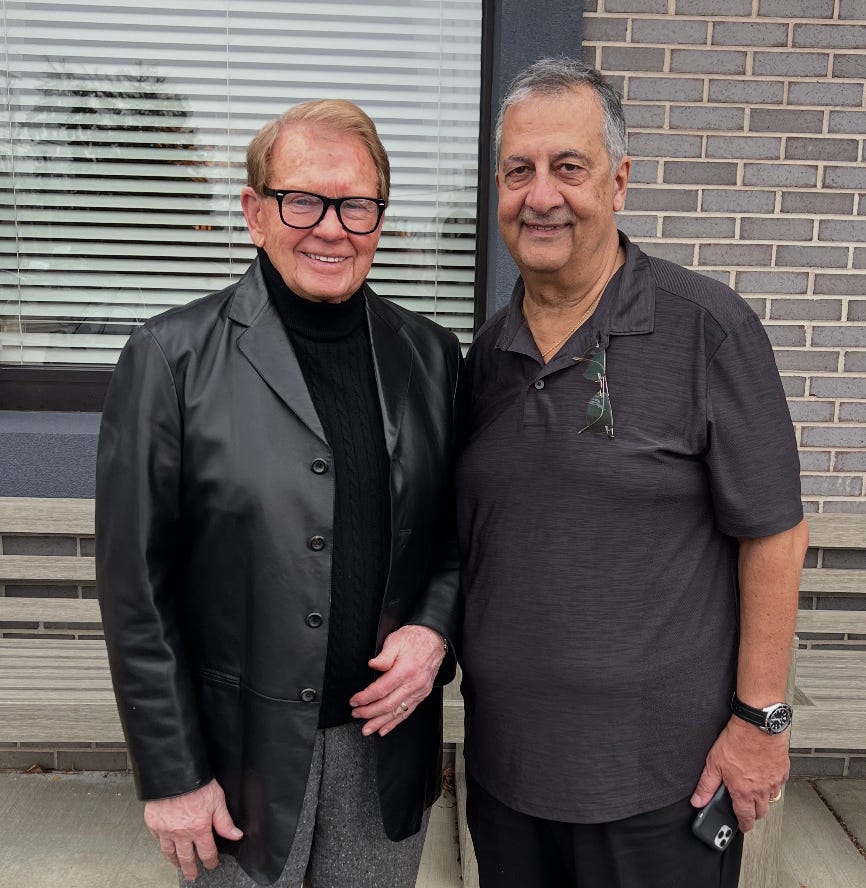
But after serving decades under Daley and then Bilandic, Donovan moved on to become one of the most influential leaders of American Finance, joining the Chicago Board of Trade (CBOT) as secretary in 1979 and becoming its President and CEO in 1982. He served nearly 20 years, described as the longest tenure in modern CBOT history. While there, Donovan is credited with ushering the CBOT into the modern computer age against the resistance of some of his jealous rivals.
After leaving the CBOT in 1998, Donovan became founding chairman of Quantum Crossings LLC, a Chicago-based technology, security, and electrical services firm organized in 2000 as a Hispanic-certified Minority Business Enterprise, with offices in Chicago’s Downtown and Pilsen neighborhoods.
I was fortunate to meet Donovan after landing my full-time desk at the Chicago City Hall Press Room, overlooking LaSalle Street from the second floor window at the Northwest corner of the room.
The City Hall Press Room was the launching-pad for some of Chicago’s greatest journalists, including Harry Golden Jr. of the Chicago Sun-Times, Bob Davis of the Chicago Tribune, Bob Crawford of WBBM News Radio 780, and Bill Cameron of WMAQ Radio.
They filled the seats held by some of the most famous “Front Page” era journalists like First Ward Aldermen Hinky Dink Kenna and Bathhouse John Coughlin, dubbed the “Lords of the Levee,” Chicago notorious red-light district operating from the 1880s until 1912.
By the time I got to my own desk at the City Hall Press Room in 1978, Chicago politics had been “cleaned up.” I was the first to bring a computer to the room. I met Mayor Richard J. Daley as a freelancer writer in 1976 after serving during the Vietnam War, but I got to know Mayor Bilandic and Donovan after I arrived.
I met Donovan in the Spring of 1978, representing the Daily Southtown Economist (which went from publishing twice each week to six-days a week on Feb. 24, 1978). Donovan had Celeste Jurkovich, Bilandic’s Press Secretary, to greet me and escort me to my privileged desk in the City Hall Press Room.
I covered Mayor Bilandic as he ran marathons across the city, was feted by the political organization at the Conrad Hilton and the Bismarck Hotel, and always would see Donovan who was professional and polite as a Chicago politician could be to anyone who worked in the “news media.”
Donovan was brilliant when it came to keeping the Machine running under Daley, but faced his biggest challenge when the Machine started to crack when confronted by Jane M. Byrne, who was one of Mayor Daley’s favorites. She served as the commissioner of Consumer Sales, Weights & Measures until she was fired by Bilandic after Daley’s death, at the urging of Vrdolyak and Burke.
Byrne did something the Machine had never experienced, used the news media to carry the weight of her campaign. Sure, the news media was on top of stories of crime and corruption in Chicago, in politics and in the Chicagoland suburbs. But they were not so confrontational as they became during that one election.
The Machine didn’t need to news media to promote its achievements,. It relied on its massive army of precinct captains, workers who pushed out the vote and handed out garbage can lids to loyal voters, like my own family living under the shadow of Pill Hill on Chicago’s Southeast Side.
Donovan was able to solve all of the major challenges the city faced under Daley and under Bilandic, until Mother Nature stepped in pounding Chicago with record-setting winter storms and arctic temperatures. More than 78 inches of snow that began on New Year’s Eve slammed the city.
Shaken by the first big snowfall–a full 22 inches–Bilandic had moved to take charge, announcing plans to clear streets, and warning residents to relocate their cars to nearby school parking lots that he said had been cleared of snow. The city rallied behind Bilandic and the Machine and it seemed to work, until 3 day later when the Bob Davis and Chicago Tribune reporters reported that all of the lots were buried deep in snow.
The CTA responded by curtailing service along its elevated routes in African American neighborhoods to get White residents from the Suburbs and outlying Chicago Wards to their jobs at the Loop.
Donovan arranged for the mayor to take back control, arranging a helicopter tour of the city with the Mayor over the snow-smothered city, and then did something unusual, invited the full-time City Hall media to a private meeting with Bilandic — “informally” — in his 5th Floor offices, without TV cameras.
While Donovan was brilliant at politics and Bilandic was a genius at finance and organization, neither could navigate the fast changing Chicago news media. Legendary columnist Mike Royko pounded Bilandic and ran Byrne’s campaign through his daily columns.
The media disclosed that Bilandic had given a $90,000 contract to Deputy Mayor Ken Sain who wrote a 90-page report on how to clean Chicago streets of snow. It didn’t work.
Sitting under a portrait of Boss Daley, Bilandic wore a dark blue-knit cap that was bunched up and tilting off to one side of his head, looking like a bad impression of the Grinch who stole Christmas. He wore a long-sleeved thermal undershirt that was pulled over his white dress shirt and tie. The thermal undershirt was too tight, and his gold-linked cuffs poked out awkwardly at the end of the sleeves.
“You know,” Bilandic began, “we tried, but it’s not our faults–it’s the way they are making car locks. You can’t get in there with a wire and unlock the locks, so we couldn’t move the cars. They don’t make cars the way they used to.” He looked at Golden and said, “You know, Harry…”
Golden nodded as if he wanted to get down every word. But when I looked over at Golden’s narrow yellow notepad, I saw that he was simply sliding his pen back and forth, creating dark lines and the impression that he was writing down Bilandic’s words. This went on for an hour.”
The storm of weather and media criticism continued until election day on February 27, 1979. The media did not let up on criticizing Bilandic, but on election day, the sun came out and temperatures warmed enough to encourage Chicagoans to go outside, and to vote. Had the weather remained as cold and as brutal as it had been, Bilandic might have survived the election..
In the days before his term in office ended, City Hall reporters had a chance to wish Bilandic and Donovan well in what would soon become Byrne’s Mayor’s 5th Floor Office. Like Bilandic, Donovan was polished, gracious and professional. There was no anger, name-calling or excuses.
That was the last time I saw Donovan until one day while shopping at Best Buy in Orland Park in 2001, Donovan was with his wife Vita and waved. Over the next few years, political history brought us together like gravity, both having served like military veterans in Chicagos’s political war.
During the past two years, I was able to sit with Donovan for weekly dinners at JC’s Ristorante (JC’s Pub) in McCook, a popular hangout for many regional politicians and elected officials, along with former 23rd Ward Alderman and Congressman William O. Lipinski and former House Speaker Michael J. Madigan, and a few others like John T. O’Connell who became a lawyer after Byrne’s victory and worked for local government.
I was fortunate to sit there as these brilliant minds shared memories and discussed the tumult of current U.S. politics.
I also joined Donovan, his wife Vita and his son, John Donovan, who inherited his father’s political mind, for dinners. The topic was always politics, recent and past, and family, children and “family values.” Donovan had strong views about where the world was headed and always led brilliantly thought-out discussions.
Tom Donovan died on June 15, 2026, after a brief illness. He is survived by Vita and is father to the late Brian, and Kevin (Debbie), John (Devon Weist), and Grace (Gino Rodriguez) Donovan. His obituary describes him as the proud grandfather of Kelsey and “Baby” Vita, and dear son of the late Roy and Dorothy Donovan from Bridgeport, Chicago. He is the loving brother of the late Patsy (late Ray) Gaglione, Dorothy (Maurice) Sullivan, John (Karen) Donovan, and David (Peggy) Donovan. Kind brother-in-law of Joseph (Barbara) Infantino. And, cherished uncle and great-uncle of many nieces and nephews.
Donovan was a principled and brilliant businessman and veteran politician. He probably would have made a great mayor himself.
My condolences to the Donovan family and a salute to the passing of another major iconic figure who forged the political atmosphere and reality of Chicagoland and the Midwest.
Terrific column! I loved that you mentioned Harry Golden Jr. (I wrote a book about his father, and remember how he spoke of his son’s reporting with huge glee.). Great history captured here, thanks. Kimberly Marlowe Hartnett