

By Ray Hanania
Russ Stewart, 76, deserves more than just a good obituary from the Nadig Newspaper, the publication where he wrote more than 2,500 political columns and analysis as a community reporter and political columnist for more than 50 years.
The Nadig Newspaper on the Northwest Side of Chicago was very similar to the Southtown Economist Newspaper on the Southwest Side of Chicago, where I solidified my journalism career after several years of freelancing for The Messenger Press and my own publication, The Middle Eastern Voice, an English-language ethnic newspaper.
I knew Russ for most of his column-writing career. We didn’t always see eye-to-eye, though, but we did agree on a few things, including that community news reporters did a better job of drilling down into local politics than the mainstream news media which covered it superficially. We were in the weeds, not looking at politics from privileged, Ivory towers.
We also shared a belief that local politicians reacted more quickly to local news reporting and good opinion analysis and that gave us a greater power to make a difference. Community newspaper columnists were the champions of the little guy, as he so often told his audiences, but as reflected in a recent Nadig Newspaper obituary, he was quoted as saying “the big guys won’t hire him.”
I think what he meant by that, in a broader sense, is that the “big guys” didn’t take community news reporting and community columnists serious enough.
Despite that, Russ Stewart reigned over Northwest Side politics but he constantly struggled to be taken seriously outside of his Northwest Side base. He deserved that respect. Unfortunately, most community newspaper reporters really get none. Most of us struggle to rise up above the financially constrained community publications in the hopes of making it to the big time.
Stewart remained at the community level as a journalism institution, while I fought to bring my “community approach” to the region at the bigger newspapers.
That’s what I did when I went from being a cub reporter in 1977 at the Southtown Economist Newspaper (later Daily Southtown) covering Southwest Side and Suburban news, to secure a coveted full-time desk to cover Chicago City Hall and politics. I later continued my “desked” City Hall coverage when I was hired by the Chicago Sun-Times in March 1985.
That was the goal for most young journalists, I thought. Start at a community newspaper and then get hired by one of the four big newspapers, the Daily News, the Tribune, the Sun-Times, and the American, which later was rebranded as Chicago Today. By the time I got into journalism, the American was gone and the Daily News was on its deathbed and within months of closing.
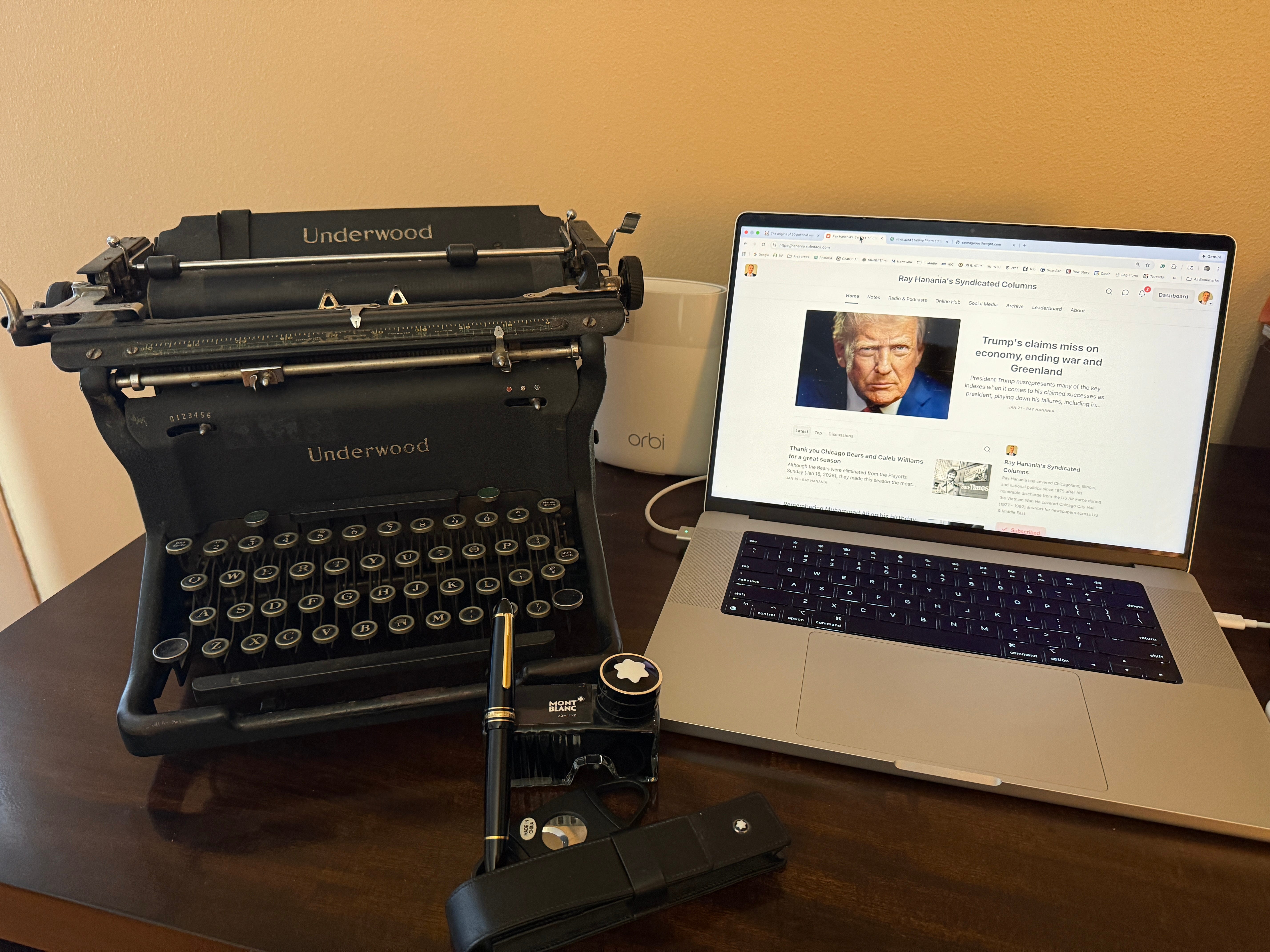
But I never forgot those community newspaper roots, that began with the Messenger Press weekly newspaper in 1975. The Community Press had a power and focus on local stories that identified with everyday people, something the major media struggled to find but often ignored because “community news wasn’t of that much interest to everyone.”
Basically news in Burbank was not of much interest to residents in Evanston. And news in Evanston wasn’t of much interest to residents in Oak Lawn.
It was a simple fact of life. The more people who liked a story, the more money a major media could make. Community newspapers had a smaller audience base, and thereby a smaller advertising base.
The only thing “local” that rose up to the news spotlight was murder. Tragedy had no inherent territorial base so death in any small suburb was of interest to audiences everywhere.
“Community news” was of interest mainly to a narrowly defined, small audience impacted by that local news coverage and reporting. The big media wanted the “big stories” which touched everyone, because “everyone” is what drove advertising profits. The narrow audience of the community media was a constant financial struggle, even though the community news was often the most impactful — though to the least number of readers.
So when I got to Chicago City Hall, I tried to blend my coverage of Chicago Citywide politics to include community angles. I wanted to make community news of interest to everyone regardless where you lived. And, I also did not forget the community media and its reporters who once were my fraternal journalism colleagues.
I noticed that the Dean of the City Hall Press Room, who I later became close friends with and even helped him and his wife at his home as he approached death, Chicago Sun-Times reporter Harry Golden Jr., would often chase people who were not “desked” at the City Hall Press Room out of the room . That included shooing out community newspaper reporters when they tried to hang out.
The big TV reporters were always welcomed, in part because TV often paid “desked” City Hall newspaper reporters a fee to appear on their talk show programs. I became a regular on weekly news and discussion programs including WMAQ TV’s “City Desk” hosted by Dick Kay, WBBM TV’s “Newsmakers” hosted by Walter Jacobson, WLS TV’s “Eyewitness Forum” hosted by reporter Andy Shaw, WGN TV’s program “People to People,” hosted by several reporters, and WTTW TV ‘s formidable Friday program, “The Week in Review” with host Joel Weisman.
The City Hall Press Room also had a large TV cabinet that was filled with bottles of alcohol, “gifted” to the reporters at Christmas and even during the year. Crown Royal in its purple valor bag was the prize, while Ald. Roman Pucinski’s Polish Vodka was so strong we had many unopened bottles.
People said I was “lucky” being at City Hall, and that Stewart and Kass, at the time, were not. But it wasn’t luck. I just approached the news from a different angle, the same angle that both Stewart and Kass, and even at the time community reporter Greg Hinz of the Lerner Newspapers, approached news stories.
When the Southtown Economist announced it was going daily on February 20th 1978, changing its name to the Daily Southtown, publisher Bruce Sagan asked reporters at a new room staff meeting, “Who wants to cover Chicago City Hall?” I was the only one ho raised a hand.
Colleagues said I was stupid, being so new. The incumbent Mayor, Michael A. Bilandic, was considered “boring” and the biggest City Hall political story was his announcements about running marathons that literally made the front page of the Chicago Tribune with Robert Davis’ byline.
Hinz pursued his own career, abandoning the community newspaper fraternity quickly after being hired by Crains. But Stewart and Kass remained true, even after Kass became the daily columnist for the Chicago Tribune.
But when John Kass of the Daily Calumet, or Russ Stewart of the Nadig newspapers, wandered into the press room, they were quickly ushered out. Until I got there.
I had a long conversation with Golden, one of the best newspaper journalists in the country, about the issue and convinced him to let Kass, Hinz and even Stewart come into the City Hall Press Room and hang out, as long as they hung out at my desk. They did. I always let them use my City Hall desk phone to make calls, take calls and work on City Hall stories.
Kass went on to break a big story and get hired as the daily columnist for the Chicago Tribune, succeeding Mike Royko who fled the Sun-Times to the Tribune when Ruppert Murdoch purchased it — only to be defamed and shoved out in a political-driven assault by a coterie of the newspaper’s far leftwing writers. He was considered too conservative for them, but he went on to publish his columns online and he is doing very well, despite the age issues that hamper all of us.
No one came close to Royko’s brilliant writing. One of his most famous quips that I remember went something like even in Chicago, there should be a speed limit on how fast you could turn a bribe.
Russ Stewart, who was also a lawyer by profession, never wanted to cover Chicago City Hall. He managed to maintain ties to the Northwest Side aldermen at the time when I was at City Hall and covered them in detail. But he would often call me to get info on City Council meetings, especially the actions and remarks of the Northwest Side aldermen.
The major news media considered the Southwest Side and Northwest Side as community news and rarely covered the day-to-day news, unless those stories rose to broader interest.
It was strange. There were some suburban cites and villages that got all the news, and eventually you could see it had to do with where the big name reporters grew up or “came from.” The media also favored the wealthy suburbs which offered a base for their advertising campaigns and advertisers.
The Southwest Side was the redheaded step-child of news coverage. The Northwest Side was slightly more favored. But the two regions were often ignored in political coverage which favored North Side and Lake Front elected officials and issues.
Like me, Stewart had to fight to get news of his region covered by the major media, although honestly, I don’t think he really cared whether the big media covered the stories or not.
They were quick to pillage his breaking stories, and my breaking stories. I remember once I got a scoop from Joe Hannon, the head of the Chicago Public Schools, and the Education Reporter at the Chicago Tribune saw it the next day, pillaged my story and re-wrote it himself.
Of course, I quickly took the issue to John Madigan, the political news journalism commentator at WBBM News Radio Seeevvvveeeeenty--Eight, who did a commentary slamming the reporter for “lifting” my scoop. I was excited not that the Tribune reporter was shamed, but that I had gotten credit for a scoop, the gold nugget sought by every good journalist.
Stewart told me during one of his rare visits to the City Hall Press Room that he didn’t care about all that at all. He really did focus on his region and analyzed it in the bigger context.
We got into our little arguments and debates on the phone. He even slammed me in one of his columns when aldermen on the Southwest Side disagreed with alderman on the Northwest Side, and we took sides.
But if you wanted to know what was happening on the Northwest Side, and to understand its politics, you had to read Russ Stewart’s columns. I did and I learned a lot.
Here’s a salute, Russ, to you at that big typewriter in the sky. I know that if Jesus does something you don’t like, you’ll probably be the first to take him on.
God Bless you buddy. You are missed. But you will be remembered, too, for the impact you had on Chicago politics at the Nadig Newspaper.
Russ Stewart’s columns are archived on his website at http://russstewart.com/.