

By Ray Hanania
The Illinois Legislature backed down from handing the Chicago Bears a $1.5 billion four decade donation from Illinois taxpayers to “keep them” in Chicago and Illinois, and to prevent them from going to Indiana.
Politicians like Gov. Pritzker and others said it would be embarrassing to have the “Chicago Bears” in Indiana and not in Chicago, a place many in the state avoid already in part because of crime and a lack of confidence in the city’s leadership.
It must be even more embarrassing, however, for the wealthy people who can afford to go to the Bears football games and enjoy its many stadium luxuries that a lot of us will never see.
Since when did anyone care about spending the taxpayer money of homeowners in the state of Illinois?
Like most people in “Chicagoland,” the average taxpayer can’t afford the good seats and miscellaneous costs at the Bears games, so they sit at home and watch the games on television where the Bears and TV stations profit from advertising.
It is costly just to watch the football game at the stadium: For a family of four going to a regular-season game can often end up costing a lot: Tickets: $800–$1,600; Parking: $40–$100; Food/drinks: $100–$200.
For a family of four sitting at home watching the game on TV while snacking on pizza, chips and drinks, it might cost, maybe, $100, total. And the home is more comfortable — big screen TVs are cheap these days, a 70-inch screen for under $700 and enjoy thousands of programs.
I enjoy watching the Bears on TV. And if they move to Indiana, I will continue to enjoy the Bears games, whether they are “Chicago Bears,” the “Hammond Bears,” or even the “Arlington Heights Bears.”
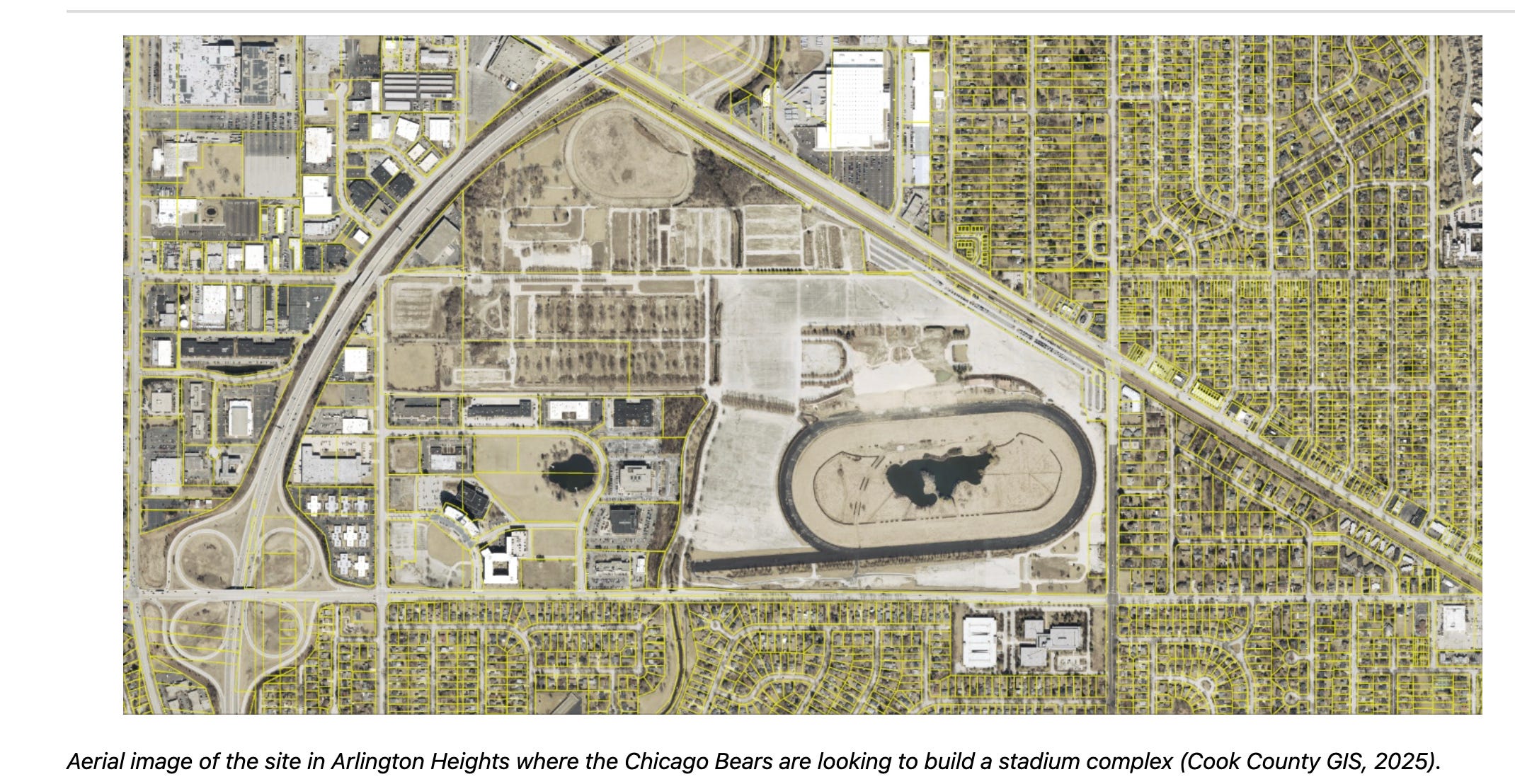
Honestly, the “cost corruption” of American sports has ruined everything for most Americans who once enjoyed live sports, from baseball to football and even soccer.
I go to the neighborhood parks if I want to enjoy a live football or baseball or soccer game.
I definitely would be very angry if Illinois lawmakers were to have passed a financial package to help the Chicago Bears make even more money than they already make.
Yea, let’s bailout the wealthy because the powerful love to watch their football games from the comfort of those high-priced special luxury suites. The Bears earned $629 million last year, and paid about $280 million in salaries.
Do they really need us to help them build a new stadium? Or was it all just a ruse to just help them keep their massive profits?
Why should the athletes complain?
I can’t blame the outrageous sports salaries on the Bears. Those salaries were corrupted a long time ago.
It used to be that we paid big salaries to the athletes who performed, like Babe Ruth in 1930 ($80,000 — more than the U.S. Herbert Hoover Truman at the time), or Joe DiMaggio in 1949 ($100,000), or Wilt Chamberlain in 1965 ($100,000). Notice how the salaries did not increase that dramatically back then over 35 years?
Now wealthy team owners pay millions just to get someone with the promise of performance. Sometimes they perform, sometimes they don’t. Meanwhile, the high salaries have priced most average Americans out of live sports attendance. We just can’t afford it, especially with all of the other massive taxes we have to face in Illinois and this country.
During World War II, soldiers lived by the rule that they were fighting for “Mom and Apple Pie.” It wasn’t until later that the beautiful slogan of a son’s love was corrupted to include “sports”. Notice where they put the “sport” in the slogan: “Baseball, mom and apple pie.”
They put sports before Mom!!!!
Why am I not surprised?
A lot of the credit for putting the brakes on a rush to pour additional taxes into the sports coffers goes to Cook County Treasurer Maria Pappas who did a detailed analysis on how the incentives would impact Cook County taxpayers.
Pappas concluded:
Massive Tax Breaks: The bill would freeze the team’s land at vacant lot levels and negotiate long-term payments in lieu of taxes (PILOT), reducing the team’s annual property tax bill from an estimated $53 million down to roughly $14 million.
Shifting the Burden: Because the massive development will require new infrastructure (roads, police, fire, and schools), a reduced contribution from the Bears means local homeowners and other taxpayers could face higher taxes to make up the difference.
Murky Returns: The analysis concluded that the long-term financial benefits for local municipalities and everyday Illinois taxpayers remain highly “murky”, primarily serving as an operating subsidy for a franchise valued at over $8 billion.
Insiders slammed the report to try to help their pals, the Bears owners.
Pappas even did an analysis of how state laws failed to prevent skyrocketing increases in property taxes in Cook County. So what they tried to do for the Bears they have been doing for other big business pals and the wealthy for years.
You know, just because Gov. J.B. Pritzker doesn’t take a governor’s salary doesn’t mean he is doing the taxpayers any favors. The salary savings is worthless symbolism when it comes to the massive tax hikes that Illinois passes every year and places on taxpayers.
Even this year, the legislature managed to pass new taxes on an already burdened Illinois taxpayer.
At least someone cares about the taxpayers, because clearly most of the legislators who voted for the Bears bailout (that failed) don’t — call it whatever you want but it is a bailout when you give a profit-making company already earning in the hundreds of millions of dollars, annual subsidies of tens of millions of dollars more so they do or don’t move someplace else.
Whenever Pritzker gathers his pals together in Springfield, you know taxpayers are going to pay even more.
And that is a bit ironic considering Pritzker is slamming President Trump for his excessive and wasteful spending burdens that are driving up inflation, grocery costs, gasoline costs and everyday life. No wonder Pritzker is so ineffective in confronting Trump. They both tax as up the wazoo, and don’t care!
At least for this season, the taxpayer team has scored a touchdown. But the moneygrubbers will come back after our taxes, and with a vengeance.
God forbid that the Chicago Bears would ever go to Indiana. What an embarrassment that would be for all those wealthy Chicago cigar chompers and insiders to have to go to a state where taxes are far lower than they are here?
(Here’s a little comparison of Illinois to Indiana, just in case you don’t believe me)
=== Income Tax
Illinois
Flat state income tax: 4.95%
No local income taxes for most residents.
Retirement income (Social Security, pensions, 401(k)s, IRAs) is generally not taxed by Illinois.
Indiana
State income tax: approximately 3.0% (rate continues to decline under state law).
Many counties impose an additional local income tax, often around 1%–3%.
Combined state and county rates can approach or exceed Illinois’s 4.95% rate in some counties.
Retirement income receives less favorable treatment than in Illinois.
=== Property Taxes
Illinois
Among the highest property taxes in the United States.
Effective property tax rates often exceed 2% of home value in many areas.
Particularly high in parts of the Chicago metropolitan area.
Indiana
Much lower property taxes due to constitutional tax caps.
Owner-occupied homes are generally capped at 1% of assessed value.
One of Indiana’s biggest advantages over Illinois.
=== Sales Tax
Illinois
State rate: 6.25%
Local taxes push rates higher.
Chicago’s combined sales tax is among the highest in the nation, around 10.25%.
Indiana
Flat statewide sales tax of 7%.
No additional local sales taxes.
=== Gas Tax
Illinois drivers pay significantly more in fuel taxes than Indiana drivers. Illinois has one of the highest motor fuel tax burdens in the country.
=== Estate and Inheritance Taxes
Illinois
Has an estate tax on larger estates.
Indiana
No estate tax.
No inheritance tax.
AFP-IL Statement on Megaproject Bill Failure
SPRINGFIELD, IL — Americans for Prosperity–Illinois (AFP-IL) today responded to the Illinois General Assembly’s failure to pass megaproject legislation before the end of session, highlighting the defeat of harmful provisions that would have put property taxpayers at risk.
The General Assembly did not rush through a late-night stadium deal that was not fully vetted and carried significant risk for taxpayers. But more work remains to be done to provide tax certainty to Illinoisians.
AFP-IL Deputy State Director Brian Costin issued the following statement:
“While AFP-Illinois is encouraged that the most dangerous provisions in this megaproject proposal (HB 910) — which would have exposed property taxpayers to significant financial risk — ultimately failed to advance, lawmakers have more work to do to provide certainty for taxpayers.
“The last-minute replacement Municipal Stadium Authority bill (HB 958) was narrower than the megaproject bill, but if it had passed, it still could have exposed Cook County taxpayers to billions of dollars in long-term risk.
“AFP-IL appreciates the work of legislative leaders in both chambers who engaged seriously on this issue and worked to incorporate AFP-backed language that would have delivered real protections, including potential property tax relief and long-term tax certainty for communities like Arlington Heights. That effort showed there is a better path forward — one that puts taxpayers first.
“AFP-Illinois has been proud to serve as a voice for taxpayers throughout this debate — not just opposing bad policy, but offering real, workable solutions that protect families and promote responsible growth. Moving forward, lawmakers should build on that work by advancing policies that deliver lasting tax certainty and relief for all Illinoisans — not just in isolated projects, but across the board.”
AFP-IL reiterated its commitment to working with policymakers to advance fiscally responsible reforms that protect taxpayers, promote transparency, and strengthen Illinois’ long-term economic outlook.
Through broad-based grassroots outreach, Americans for Prosperity (AFP) is driving long-term solutions to the country’s biggest problems. AFP activists engage friends and neighbors on key issues and encourage them to take an active role in building a culture of mutual benefit, where people succeed by helping one another. AFP recruits and unites Illinoisans behind a common goal of advancing policies that will help people improve their lives. For more information, visit www.AmericansForProsperity.org.
View this release online HERE.
Amen.
I think the limit on real estate taxes in Indiana is 1% of market value.