

By Ray Hanania
Outer space travel and nuclear war were tightly wound together in the minds of Americans in the early 1950s, when I was born.
I was in first grade at Thomas Hoyne Elementary School at 89th and Crandon on Chicago’s East Side neighborhood when the school would have the students prepare for a surprise nuclear bombing.
They didn’t use those words, but the school would sound an alarm, and the kids would line up and go into the hallway and crouch down against the wall with our hands over our heads.
I was six years old, and it was kind of fun. We weren’t thinking about being fried by the fiery radiation of a nuclear war launched by the Soviet Union. I was with my friends, Nancy Cranston and Olivia, and I was wearing a red Robinhood hat with a feather on my head.
We knew it was important because the news for several years before that memory of crouching with friends against the painted cinderblock wall to “protect” us from nuclear devastation was dominated by how the Soviets wanted to destroy America.
The Soviets had launched a satellite called Sputnik in October and then again in November of 1957. Months later, America launched a satellite, too, called Explorer 1.
My dad served in the 5th Army with the O.S.S., the precursor to the C.I.A., during World War II, and he was always talking about how we couldn’t trust the Soviets or the “Commies,” former partners who helped defeat the Nazis.
The big news was that even though the Soviets got to outer space before America, America beat the Soviets in significance when TV news anchors reported that Explorer I had discovered something called the “Van Allen Radiation Belt.”
The name “Van Allen” sounded like someone who appeared on our little Black and White television set with the big rabbit ear antennae on a game show.
I remember asking my dad, “How did Van Allen lose his belt? Was it on TV? And was it in outer space?”
It made no sense to me.
We grew up in the 1950s in an atmosphere of incomprehensible fear on our minds. It was bad, but I couldn’t fathom how bad it could be. We just had to get out from our desks in school and crouch down in the school hallway that we walked every day, and we would be safe.
Safe from what?
It was imagination. And there was a fixation on who would get to the Moon first, to protect us from whatever our imagination conjured up in fear.
Right about that time, the theatrical movie made two years before I was born, “The Day the Earth Stood Still,” was broadcast on our TV in 1957. And that was followed by a series of nuclear and outer space monster movies. One of my TV favorites was “Them,” the giant ants created during nuclear bomb testing in the New Mexico desert.
And then in 1961, President John F. Kennedy announced during a joint session of Congress – I had no real sense of what “Congress” was – that America would land an American on the Moon before the end of the 1960s. JFK said we were in “a race to the Moon” with the Soviets and we would get there first. I always thought of the TV series “The Honeymooners” with Jackie Gleason, who would tell his wife when he got angry, “To the Moon, Alice. To the moon.”
That’s when we became familiar with “astronauts,” which was a little confusing for kids my age who were excited about the movie called “Jason and the Argonauts,” a Greek fantasy about an explorer searching for the Golden Fleece.
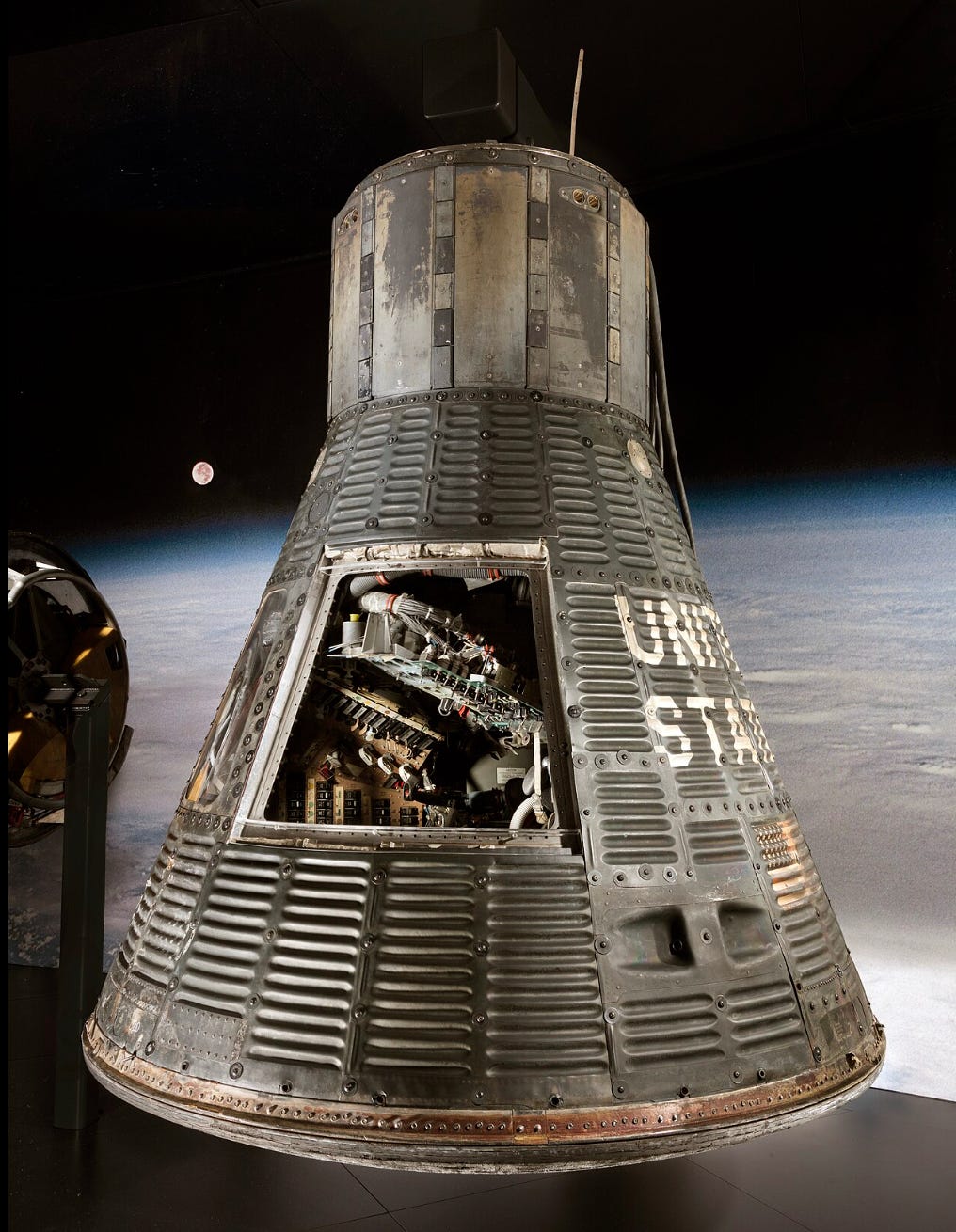
Alan Shepard became the first American in space in 1961, and John Glenn became the first astronaut to orbit the Earth in 1962, both in “Project Mercury.” There was another astronaut around then, Scott Carpenter. That year, two of my neighbors on Luella Avenue named their newborn sons Scott and Glenn. (Glenn Morrow would be in his 60’s, today.)
That was cool because I had received a “Chemistry Set for Christmas about that time, which included all kinds of chemical substances, including a little plastic bottle of “Mercury” that you could roll in your hands and play with.
Turns out, of course, that Mercury is very unhealthy and highly toxic to human health.
But I survived worse. I used to eat that White Paste Glue in school when I got hungry, pasting cutouts from the colored newspaper comic strips together with a cap-brush for Art class projects.
My memory was sharp back then and very impressionable. One day, returning to Joseph Warren Elementary school from lunch at home, walking up the sidewalk at 92nd Street and Chappel Avenue, a friend yelled through the chain link fence from the asphalt playground, “The president was killed.”
That’s when things started to get burned into my young, impressionable memory.
I remember watching with my dad as they broadcast a live transmission from Apollo 7 while in orbit, for the first time. And then TV news broadcast live the recovery of the Apollo 7 capsule, in October 1968. The astronauts were Wally Schirra, Donn Eisele, and Walt Cunningham (I had to look up their names), who splashed down in the Atlantic Ocean.
My dad died a year later, when I was 16, and it has always been a cherished memory for me.
I watched with my family on live TV when Apollo 11 landed on the Moon in July 1969, along with some 650 million other viewers, who watched Neil Armstrong take his historic first step on the Moon. He uttered the words that burned in my brain, “That’s one small step for man, one giant leap for mankind.”
That was followed by a debate over whether he said “man” or “a man.”
And as I got older, of course, I remember being in the offices of the Chicago Sun-Times, talking with editor and friend Earl Moses about a story in January 1986 when we paused to watch the launch of the Space Shuttle Challenger. Just over a minute into the launch, it had exploded live on TV.
It was terrible and changed that week’s news story focus away from another City Hall political scandal.
Teacher and civilian astronaut Christa McAuliffe was on that doomed flight. She was Arab American, although the news didn’t really talk about that much because being “Arab” was like a derogatory four-letter word.
Then there was the disaster in February 2003 when the Space Shuttle Columbia exploded over Texas, minutes before its scheduled landing.
The last Space Shuttle mission was in 2011. We have the International Space Station, but we don’t hear much about it, except when tensions increase between America and Russia – the two nations that partnered on it.
It was exciting to be there when the space program began. Depressing when there were disasters, including in 1967 during a launch rehearsal, when the Apollo 1 caught fire, killing astronauts Gus Grissom, Ed White, and Roger Chaffee. I remember Grissom, but I admittedly had to look up the names of the other astronauts who died with him in that blaze.
Watching the live launch of the four Artemis II astronauts on a 10-day mission that took them around the Moon, and watching their live landing Friday night in the Pacific Ocean, reminded me of all that.
I hope we get back to the Moon and one day build a base there: But just trying to get back to the moon because, as JFK said, “we choose to go to the moon,” is very exciting and inspirational.
I hope we make it. And maybe, just maybe, the revival of the Moon mission might be the catalyst that repairs this broken nation and brings Americans back together.
If we can get to the Moon, I think we can also bridge the ugly political polarization that has divided this country.